Commentary
Strong showing from Flávio Bolsonaro in Brazil’s first round of presidential elections sends stocks flying
October 22, 2026

Flávio Bolsonaro’s strong showing in the first round of Brazilian presidential elections on the 4th of October was the catalyst for a sharp rally in the Ibovespa Index this month. In previous commentaries, we argued that the market trading at a price-to-earnings ratio of around 8x reflected political uncertainty. Further, we suggested the emergence of a credible conservative candidate to contest the elections would be fuel for outperformance relative to broader EM equities.
In our view, São Paolo governor Tarcísio de Freitas and Mission Party leader Renan Santos would have been the most credible right-wing contenders. We were wrong to discount the chances of a Flávio Bolsonaro candidacy, largely based on his connection to Daniel Vorcaro, who has been engulfed in a vast financial and political fraud case.
Senate swings to the right
Despite Flávio’s many glaring flaws as a candidate, he posted a stronger-than-expected showing in the first round of presidential elections taking 47.0% in the runoff against Lula’s 45.1%. Polls had understated Flávio’s performance by about 5pts.
In the second-round runoff with Lula, Flávio is the clear favourite. He needs only about half of the roughly 7.7% first round vote share that went to other, mostly right-leaning candidates. The first-round leader has won every runoff since 2002.
Arguably, the most important shift was in the 81-seat Senate where the number of seats held by the left-wing Social Democratic Party (PSD) collapsed from 14 to five, the right-wing Liberal Partyrose to 28 seats from 15, while a right-of-centre bloc controls 48 seats. So even if Lula were to win the presidency, he would face fierce opposition in the Senate.
Yields plummet and rate-sensitive stocks outperform
The Ibovespa soared by over 12% in USD terms the day after the election results were announced, with investors anticipating a more market-friendly administration. We currently hold a modest overweight to Brazilian equities and, over a period of months, have been tilting the risk budget within the allocation to more rate-sensitive names that would benefit from falling yields on the prospect of a return to a more conservative fiscal policy.
These stocks outperformed through the post-first-round period, bolstered by policy announcements from the Bolsonaro team which suggest they plan to hit the ground running should they take out the second round.
Economic advisor to Flávio Bolsonaro, Luiz Felipe Trevisan, posted a series of policy commitments with some set for immediate rollout (before inauguration via Congress):
- “Super PEC” fiscal package: Plan to leverage political momentum immediately post-election to pass a R$190–200B (~1.5% of GDP) spending cut before inauguration. Focuses on internal state efficiency (administration reform, cutting 10 ministries, fraud reduction, asset sales) without touching social benefits, pensions or immediate LCI/LCA tax incentives.
- Ending re-election as bargaining chip: Proposes abolishing presidential re-election to gain Congressional support for tough fiscal reforms, positioning this as a single-term legacy play to build a bridge for Tarcísio in 2030.
- Budget and institutional governance: Aims to reform expenditure rules so Congress and the Judiciary share accountability for the spending they create. Includes setting 15-year term limits and minimum qualifications for Supreme Court (STF) nominees.
- Pro-growth and capital markets: Targets boosting infrastructure investment to R$500B/year, maintaining full Central Bank independence, revoking ~1,000 regulations (“Economic Freedom 2.0”), and levelling tax treatment on corporate debt to attract foreign credit.
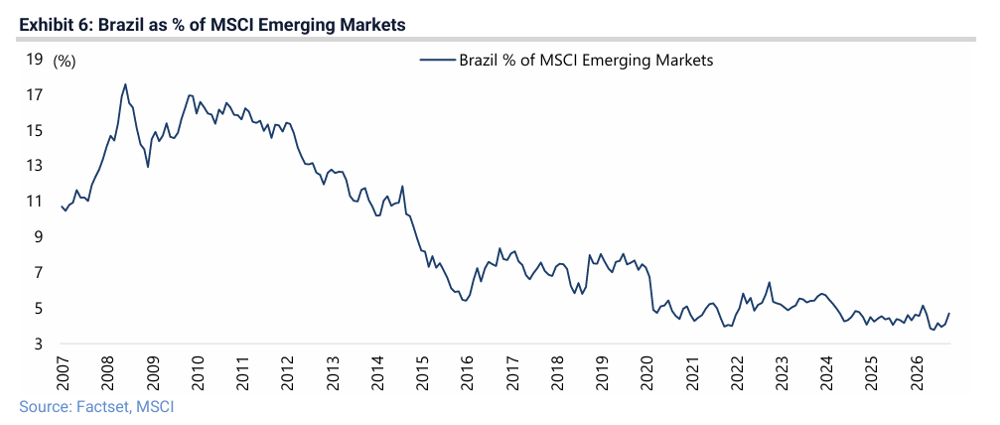
Since the 2000s mining boom the share of Brazilian equities has collapsed.
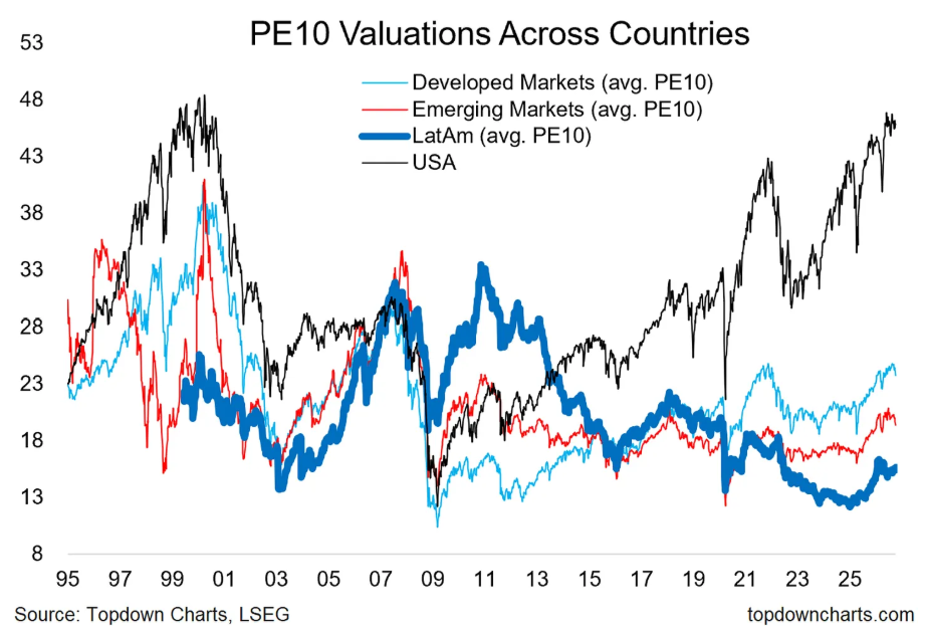
While EM valuations look attractive overall, Brazilian equities look especially cheap and poised to outperform on a better macro backdrop.
There is no shortage over high-quality companies in this deep market, and we have been building a long list of candidates which fit our stock selection process to take advantage of further positive developments.